Category Archives: History
Mind over matter
 As I walked early this morning on the peaceful tree lined streets of my 1960’s neighborhood, I thought about the difficulty in knowing anything about our reality with certainty. Looking around, I tried to find some anchor that would help me reconcile my paranormal experiences to the everyday physical world.
I look at the rust on a sign pole. I know the steel of the pole to be strong without needing to test it, in spite of the minor decay. I understand the oxidization that creates the rust. It is a regular and predictable process. The rust is is a simple material component of the tangible world. A mundane counterpoint to my esoteric thoughts, with no real bearing on my life or my musings. Or is it?
Are the literal nuts and bolts of this sign the only basis of reality, or is the material world an illusion? Does the rust really exist or only my perception of it? If my reality is determined by my perceptions or observations, why would I bother to perceive the rust when I would prefer a more uniform finish? What meaning or purpose could this little patch of decay have for me, a living and presumably conscious being?
Letting this muddle stew a while in the back of my mind, I decided to learn a little more about the rust that so rudely defaces this once proud symbol of civilization and progress. I needed to brush up since my last science class was a few decades ago.
- Iron is a relatively abundant element in the universe. The sun and many types of stars contain iron in quantity.
- The Earth’s molten core is thought to be composed mainly of iron. This core is believed to be the source of Earth’s magnetic field, which protects our atmosphere from radiation that would destroy it, and incidentally us.
- The red of Mars is ferric oxide, showing that the atmosphere once contained oxygen, the oxygen that is only liberated by life.
- The iron group are the only metals that fall from the sky. Iron is found native in about 6% of meteorites.
- Iron is a shiny, bright white metal that is soft, malleable, ductile and strong.
- Iron is the most abundant metal on Earth, but in its pure form rapidly decays. It is only found naturally in it’s metallic form in meteors. So how did the first iron metals come to be smelted by humans?
- Like other metals, iron forms a crystalline ionic compound when bound by ‘resonance’ to carbon. The resulting forms can have special electrical properties when molten or dissolved in solution.
- There are multiple forms of iron. One form is magnetic, but when iron is transformed into another form, the magnetism disappears, although the lattice remains unchanged.
- Iron is vital to plant and animal life. In humans, it appears in the hemoglobin molecule in our blood.
- Ferrous sulphide can form crystalline FeS2, known as the mineral pyrite. Pyrite can be struck with iron to produce sparks for making fire.
- The ferrous ion is greenish in solution, while the ferric ion is a light violet. The distinct colors of iron compounds are due to the d-electrons, which can interact with light in many interesting ways. Various ferrous compounds have been used to color dies, paint, inks and glass.
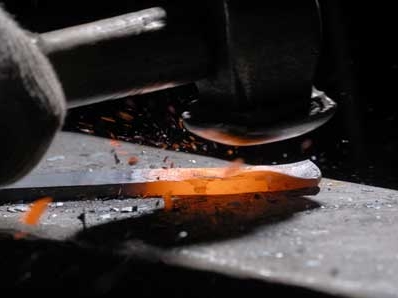
- The ability to smelt and work iron into usable forms was instrumental in the development of human civilization.
- Iron is also found in minerals such as magnetite, which is commonly seen as black sands along beaches and stream banks. A layer of magnetite can be an indicator of the presence of gold dust.
- For manufacturing the versatility of iron-carbon alloys, such as steel, cannot be matched in any other material.
- Iron can be induced to provide a strong magnetic field with only small excitation by an electric current.
- Potassium ferrous ferricyanide is Prussian blue, which can be used as a medicine to counter some forms of radiation poison.
- The magnetism of the iron group of metals is a rare and remarkable property. It is not due to any inherent magnetic propensities of the atoms, but to the structure of the metal.
- The six ton Iron Ashoka Pillar of Delhi is about 1600 years old, 98% pure iron and has not corroded. This artifact is believe to demonstrate the technological sophistication of past civilizations.
For more fascinating info on iron see http://mysite.du.edu/~jcalvert/phys/iron.htm.
Upon reflection, the rust I pass every day and take for granted is in fact a demonstration of the unmatched power of elemental iron to shape and reshape our body chemistry, our technology, our art, our civilization, our planet, our atmosphere, our stars and our future. The power of this element comes not from its stability, but from its instability and its readiness to react with carbon and oxygen which are literally the core components of life. True alchemy is not to turn lead into gold, but to turn star dust into life and clearly iron is the catalyst that enables that to happen.
My new respect for rust causes me to reflect on the illusion that material reality is fixed and static. It only appears so due to the limited range of our basic senses, infrequent insight and short lifespans. A never ending flow of wave-particles, fields and forces compose everything around us. They just happen to produce an artifact that we call the material world. All of the things around us are constantly changing, while we exert our greatest effort to bend even a tiny portion of matter to our will.
Clearly the universe felt I needed a lesson in humility today. Point taken.
 Visionary Explorer